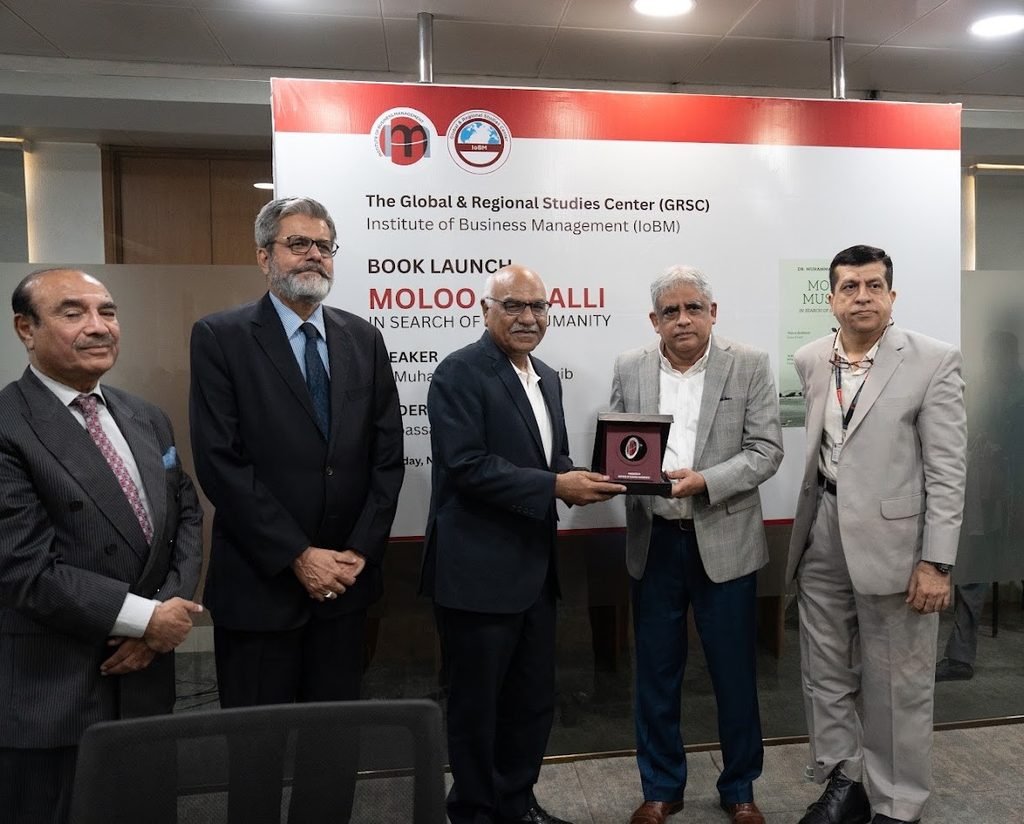
The Institute of Business Management (IoBM), through its Global and Regional Studies Centre (GRSC), organized a book launch ceremony for Moloo Musalli, authored by Dr. Muhammad Amjad Saqib, Founder and Executive Director of the Akhuwat Foundation, on Thursday, November 5, 2026.
The ceremony brought together the author, IoBM’s senior leadership, management and faculty members for an occasion celebrating literature, ideas and intellectual engagement. The moderator of the session was Ambassador G. R. Baluch, Director, Global and Regional Studies Centre, IoBM.
In his address, Mr. Talib Syed Karim, President, IoBM, emphasized the importance of creating sustainable solutions to support underprivileged communities. He observed that providing free food, while addressing immediate needs, is not a sustainable long-term approach. Instead, efforts should focus on creating opportunities that enable disadvantaged individuals to become self-reliant, support themselves and improve their lives. He stressed the need for sustainable programs that empower people to thrive. Referring to Akhuwat University, he highlighted the importance of learning from its model and suggested that the Akhuwat Foundation’s work be studied as a case study for its approach to social development and community empowerment.
While sharing his remarks for the book and the author, Ambassador G. R. Baluch, highlighted the importance of empathy, human dignity, social responsibility and inclusive development. He described the book as more than a collection of stories, calling it an invitation to recognize the lives and struggles of people who often remain unheard and overlooked. He appreciated Dr. Muhammad Amjad Saqib’s contribution through Akhuwat’s Islamic microfinance program, which demonstrates how the principle of Qarz-e-Hasana (interest-free loans) can help people build livelihoods and become self-reliant. He described Akhuwat as an example of social entrepreneurship rooted in faith, solidarity and a commitment to addressing human needs.
Referring to the book, Ambassador Baluch noted that Moloo Musalli brings together the experiences of people whose stories rarely enter mainstream conversations. Through accounts of poverty, discrimination, exclusion and injustice, including the experiences of women, laborers, persons with disabilities and transgender individuals, the book challenges society to look beyond labels and recognize the dignity of every individual, regardless of social or economic standing. He observed that the book highlights not only individual hardships but also wider social challenges, including caste prejudice, exploitative debt, bureaucratic indifference and the exclusion of disadvantaged communities. At the same time, it captures the courage and resilience of people striving for a better life.
Emphasizing the role of educational institutions, Ambassador Baluch said that universities must go beyond preparing professionally successful graduates and cultivate responsible citizens who understand social realities and contribute to addressing public challenges. He noted that Moloo Musalli offers students an opportunity to learn from the experiences of people whose voices are often missing from official reports and academic discussions.
He further remarked that while a book alone cannot eliminate poverty or injustice, it can challenge indifference, encourage empathy and inspire meaningful social change. Congratulating Dr. Saqib, he appreciated his ability to combine social service with scholarship and expressed hope that the book would encourage readers to question social inequalities, recognize human dignity and translate reflection into action.
This was followed by an address by the author, Dr. Muhammad Amjad Saqib, who shared his personal journey, the inspiration behind the book and the experiences that shaped his work. Reflecting on his early life, he spoke about his humble beginnings and his time at Government College, Lahore. After completing his MBBS, he felt that there was much more he could contribute to society. He shared the thought that stepping away from the familiar can open the door to a new world of opportunities and possibilities. This belief led him to establish a Qarz-e-Hasana (interest-free loan) initiative to support people from underprivileged backgrounds who wished to improve their circumstances through their own efforts. He shared that Akhuwat has distributed nearly seven million loans, maintaining a repayment rate of 99 per cent since its establishment.
Explaining the idea behind Moloo Musalli, Dr. Amjad Saqib said that the book brings together the lives, faces and stories of people living in remote and often overlooked areas. He explained the contrast between the name Maula Baksh, associated with an affluent person, and Moloo, representing someone born into a deprived family. He also discussed the historical and social context of the term Musalli and the marginalization experienced by the community.
Through the title, the author draws attention to people who continue to struggle for justice, a home and equality. He shared that over his 25 years of work; he had met many people who entrusted him with their personal stories. Having listened to their experiences, he felt a responsibility to share them with the wider world.
Dr. Amjad Saqib narrated two stories from the book, offering a glimpse into the lives of people whose struggles often remain unheard. He explained that Moloo Musalli is not merely a collection of stories about hardship and marginalization; it also carries a message of hope and the possibility of a better tomorrow.
During the question-and-answer session, Dr. Saqib emphasized that meaningful change begins at the individual level. He encouraged participants to reflect on the distinction between needs and wants and how these shape the way people live their lives. He also highlighted the importance of education and the wisdom of elders in building a nation that aspires to progress and move forward.
The event concluded with an opportunity for participants to interact with the author and learn more about Moloo Musalli.
The ceremony was organized by the Global and Regional Studies Centre as part of IoBM’s efforts to promote intellectual discourse, literary engagement and dialogue on issues of social and regional significance.
