The 10th International Conference on Islamic Banking and Finance (ICIBF 2026) organized by the Institute of Business Management (IoBM) provided a platform for national and international stakeholders to exchange knowledge, examine emerging trends, and explore practical approaches to strengthening Islamic banking and finance as a contributor to Pakistan’s financial inclusion, economic development, and transition towards a sustainable, Riba-free financial system.
“15% growth in the private sector during FY2026 reflects improving investment opportunities and a more favorable business environment in Pakistan.”
This was highlighted by Mr. Khurram Schehzad, Advisor to the Federal Finance Minister, while presenting Pakistan’s macroeconomic outlook at the inaugural session of the 10th International Conference on Islamic Banking and Finance (ICIBF 2026), organized by the Institute of Business Management (IoBM). The conference commenced on November 18 under the patronage of the Accounting and Auditing Organization for Islamic Financial Institutions (AAOIFI), Bahrain.
Held over two days, ICIBF 2026 brought together national and international policymakers, banking leaders, academics, researchers, and financial experts to discuss the role of Islamic finance in Pakistan’s economic transformation and its transition towards a Riba-free financial system.
Organized through IoBM’s College of Business Management (CBM) and Centre for Islamic Business & Finance (CIBF), the conference carried the theme “Islamic Finance for National Transformation: Building a Riba-Free, Digital, Inclusive and Sustainable Economy.”
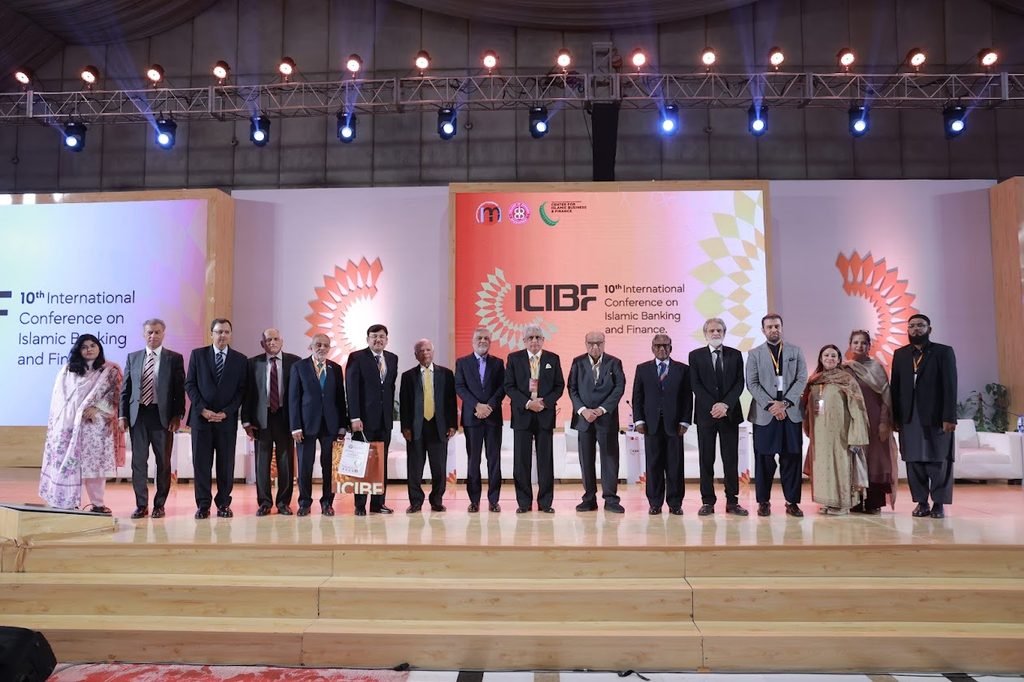
The inaugural session featured distinguished speakers, including H.E. Dr. Mohamed Waheed Hassan, Former President of the Maldives; Dr. Ishrat Husain, Former Governor of the State Bank of Pakistan; Mr. Khurram Schehzad, Advisor to the Federal Finance Minister; Mr. Saleem Ullah, Deputy Governor of the State Bank of Pakistan; and Hon. Justice Dr. Syed Muhammad Anwer, Chief Justice of the Federal Shariat Court of Pakistan.
The conference was attended by IoBM’s senior leadership, including Mr. Talib Syed Karim, President; Mr. Bashir Janmohammad, Chancellor; Prof. Dr. Tariq Rahim Soomro, Rector; Prof. Dr. Muhammad Kashif, Dean, College of Business Management (CBM); Prof. Dr. Muhammad Abbas, Dean, College of Computer Science and Information Systems (CCSIS); Dr. Nadia Ayub, Dean, College of Economics and Social Development (CESD); and Prof. Dr. Imam Uddin, Director, CIBF, and Associate Dean, Industry Linkages, CBM. Heads of Departments, faculty members, and members of the management also attended the conference. CBM Associate Deans Dr. Shagufta Rafif and Dr. Sarah Wali Qazi, along with faculty members from CBM departments, provided on-ground support throughout the event.
During the inaugural session, Mr. Talib S. Karim, Mr. Bashir Janmohammad, Prof. Dr. Muhammad Kashif, and Prof. Dr. Imam Uddin shared their perspectives on the evolving landscape of Islamic finance and its role in Pakistan’s economic development. Their remarks highlighted the importance of strengthening the Islamic banking sector, promoting collaboration among academia, industry, and policymakers, and creating an enabling environment for financial innovation. They also underscored the need to advance financial inclusion, strengthen institutional capabilities, and promote a sustainable and equitable financial system aligned with the principles of Islamic finance.
Presenting Pakistan’s economic outlook, Mr. Khurram Schehzad shared a three-year comparison of key economic indicators, including GDP growth, per capita income, foreign exchange reserves, agriculture, industry, and fiscal deficit. He highlighted the country’s economic progress, ongoing reforms, and future prospects.
Former Maldives President Dr. Mohamed Waheed Hassan observed that Islamic finance had evolved from a niche sector into a global force with a significant presence in international capital markets. He identified regulatory harmonization and effective legal frameworks as key requirements for the industry’s continued growth.
Dr. Ishrat Husain, former Governor of the State Bank of Pakistan, examined the evolution of Islamic banking in Pakistan and the planned transition by 2028. He emphasized the growing demand for Islamic finance and urged policymakers to address the remaining challenges to ensure a smooth transition and shape the future of Islamic banking beyond 2028.
Mr. Saleem Ullah, Deputy Governor of the State Bank of Pakistan, highlighted growth of over 49% in Islamic banking financing over the past year. He also discussed capacity-building initiatives and welcomed the Government’s post-2027 financial system strategy as an important step towards the 2028 transition.
Hon. Justice Dr. Syed Muhammad Anwer, Chief Justice of the Federal Shariat Court of Pakistan, stressed that Islamic finance should be asset-based and supported by stronger public awareness and education. He called for Islamic Social Finance to be developed as a distinct field, institutionalized, and promoted as a means of advancing the United Nations Sustainable Development Goals (SDGs).
Discussions on Islamic Banking, Financial Inclusion and Digital Transformation
Beyond the keynote addresses, the conference featured extensive discussions on the roadmap towards a Riba-free financial system, banking transformation, leadership, financial inclusion, national economic reform, professional skills development, and sustainable finance. A Presidents and CEOs Roundtable brought together leading banking executives to examine the opportunities and challenges facing Pakistan’s Islamic banking sector.
A major focus was the role of Islamic financial instruments in financing the real economy. Participants examined Sukuk, investment opportunities, enterprise financing, and the potential of Islamic capital markets to mobilize resources for productive economic activities. Discussions also covered Takaful and Islamic insurance, particularly their contribution to risk protection, financial resilience, and public confidence in financial institutions.
Financial inclusion and development finance were also important areas of deliberation. Participants discussed expanding access to banking services in rural communities, supporting micro, small, and medium enterprises (MSMEs), and empowering underserved segments of society. The discussions highlighted how Islamic finance could facilitate broader economic participation and contribute to community development.
Regulatory frameworks and Shariah governance received considerable attention. Discussions examined institutional accountability, transparency, and effective Shariah oversight as essential elements in strengthening public trust in Islamic financial institutions. Participants also explored the development of Islamic capital markets, including Sukuk, investment funds, and Modarabas, and the regulatory frameworks required to support Shariah-compliant financial products.
Digital transformation and financial technology emerged as another significant area of discussion. Research presentations examined digital financial inclusion for women, asset tokenization, AI-assisted financing decisions, digital supply chain financing, and the ethical governance of artificial intelligence in Islamic finance.
The academic sessions provided researchers and scholars with a platform to present studies on Islamic corporate governance, investment decision-making, financial engineering, climate change and financial stability, environmental, social and governance (ESG) practices, and the relationship between Islamic financial instruments and sustainable development goals.
Strengthening Academia-Industry Collaboration
The conference also emphasized the importance of strengthening partnerships among universities, financial institutions, regulators, and industry professionals. Discussions highlighted the need to develop human capital, promote applied research, strengthen institutional capacity, and prepare the next generation of Islamic finance professionals to meet the industry’s evolving requirements.
The two-day conference concluded with discussions on institutional collaboration, Shariah implementation, research development, and future priorities for Islamic finance in Pakistan. The proceedings also included conference recommendations and the Karachi Declaration.
ICIBF 2026 provided a platform for national and international stakeholders to exchange knowledge, examine emerging trends, and explore practical approaches to strengthening Islamic banking and finance as a contributor to Pakistan’s financial inclusion, economic development, and transition towards a sustainable, Riba-free financial system.
Pre-Conference Workshop on Emerging Frontiers in Islamic Finance
As part of the activities leading up to ICIBF 2026, IoBM’s Centre for Islamic Business & Finance (CIBF) organized a pre-conference workshop titled “Emerging Frontiers in Islamic Finance: Tokenization, Grounded Theory & Banking Practice” on November 17, 2026, a day before the conference commenced.
Held at IoBM’s EMEC, Admin Block, the workshop brought together academic researchers and professionals to examine emerging developments in Islamic finance, with particular attention to the Shariah and economic dimensions of Real-World Asset (RWA) tokenization, qualitative research methodologies, and contemporary Islamic banking practices.
The first technical session, “Tokenization in Islamic Finance: A Shariah and Economic Perspective,” was conducted by Dr. Mufti Muhammad Omer Rafique, AAOIFI Certified Shariah Advisor and Auditor (CSAA), SECP Certified Shariah Advisor, and Assistant Professor at SZABIST Karachi. His session explored Real-World Asset tokenization, smart contracts, AAOIFI Shariah Standard 62, Shariah compliance requirements, and recent regulatory developments in Pakistan and internationally.
The second session, “Grounded Theory in Islamic Finance Research,” was led by Dr. Shafiullah Jan, Director of the Center for Excellence in Islamic Finance (CEIF) and Tenured Professor at the Institute of Management Sciences (IMSciences), Peshawar. He discussed qualitative research methodologies, conceptual framework development, inductive coding, theory building, and publication standards in Islamic finance research.
The workshop highlighted the importance of integrating Shariah principles, robust academic research, and practical banking knowledge to address emerging opportunities and challenges in Islamic finance. It also provided participants with insights into the application of contemporary research methods and financial technologies within the Islamic banking sector.
The programme concluded with a closing session, presentation of shields, and refreshments. The workshop was organized by the Centre for Islamic Business & Finance (CIBF), College of Business Management, IoBM, as a pre-conference academic activity for ICIBF 2026.
